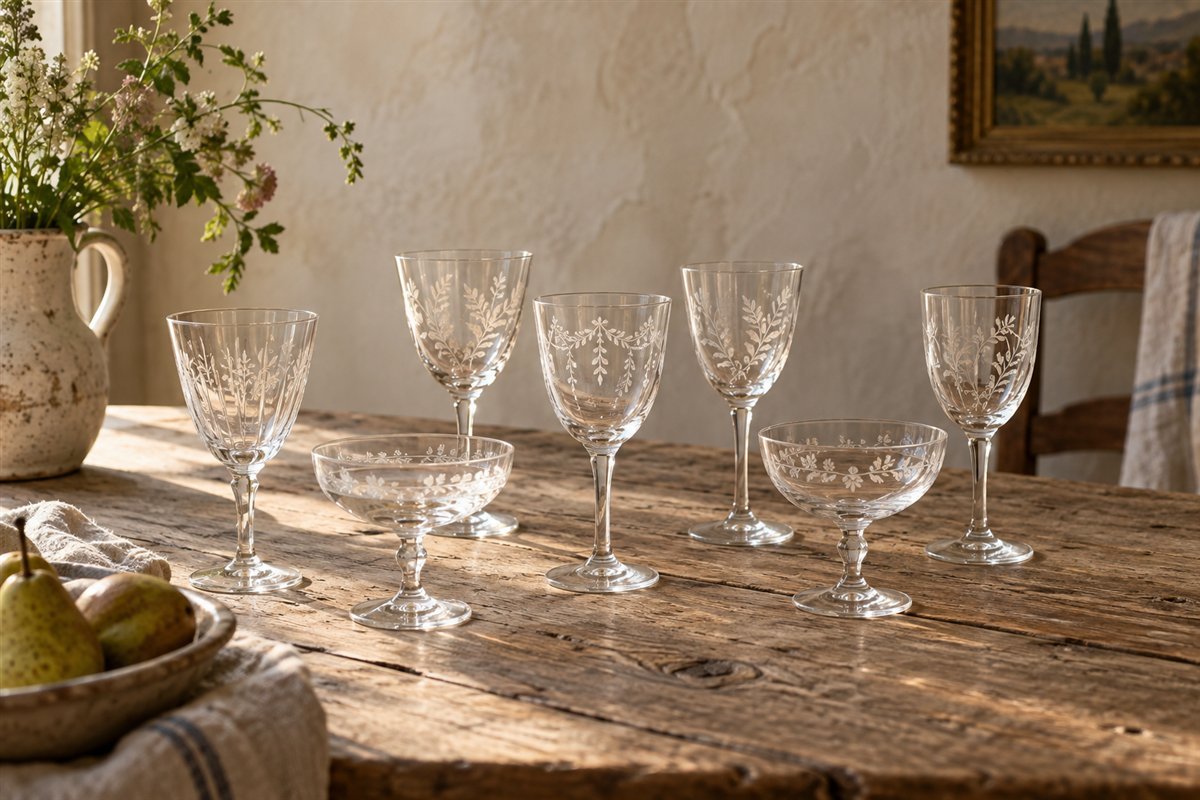
Compare the decoration and the glass shape
Ask for one photograph against a plain background and another showing the full outline. Record the motif, its position on the bowl and the spacing between repeated elements. A flower, garland or band can look convincing in a close-up while the bowl beneath it has a different profile.
For a replacement, compare the rim width, overall height, bowl depth and foot diameter. Include the stem profile and any decorative knop. A photograph beside a ruler is more useful than a description such as “standard wine glass.” If the seller gives capacity, ask how it was measured.
What can an etched pattern tell you?
Decoration alone does not establish the maker, country or date. The Corning Museum of Glass documents several historical engraving techniques, including diamond-point and copper-wheel engraving. A listing that uses “etched” loosely may not identify the process precisely. Read Corning’s introduction to engraving techniques.
Ask what supports an attribution: a maker’s mark, a catalogue match, a documented pattern or the history of the particular set. Record an uncertain attribution as uncertain. Do not turn a similar online photograph into a definitive identification.
Inspect the rim, foot and stem separately
Request close-ups of the rim all the way round, the underside of the foot and the stem joins. Ask the seller to distinguish chips, scratches, cloudy areas and repairs. Check every glass in the lot: a photograph of the best example does not describe the condition of the others.
Handle fragile glass with support and avoid knocking pieces together. The Canadian Conservation Institute identifies impact and handling as major sources of damage. Read its glass and ceramics care guidance.
Matching glass or deliberate mix?
For a close match, create a reference sheet with your photographs and measurements, then compare each candidate against it. If you prefer a mixed table, decide which features should repeat: height, colour, bowl shape or decorative theme. Describe the result as a mixed selection rather than a uniform original set.
- Reference photographs: full profile, motif, foot and any mark.
- Dimensions: height, rim and foot diameters.
- Quantity: pieces needed and acceptable variation.
- Condition: faults you would or would not accept.
- Budget: include packing and delivery.
Start with our vintage wine glass collection guide. If you want help looking for a missing piece, send a search enquiry; we review each request before agreeing a search.
Common questions
Does the same pattern mean the same maker?
Not necessarily. Compare marks, dimensions, bowl shape and documented references before treating two glasses as a match.
Should all vintage glasses in a set be identical?
Describe what is actually present. A mixed set can be attractive, but differences in height, shape, pattern and condition should be disclosed.