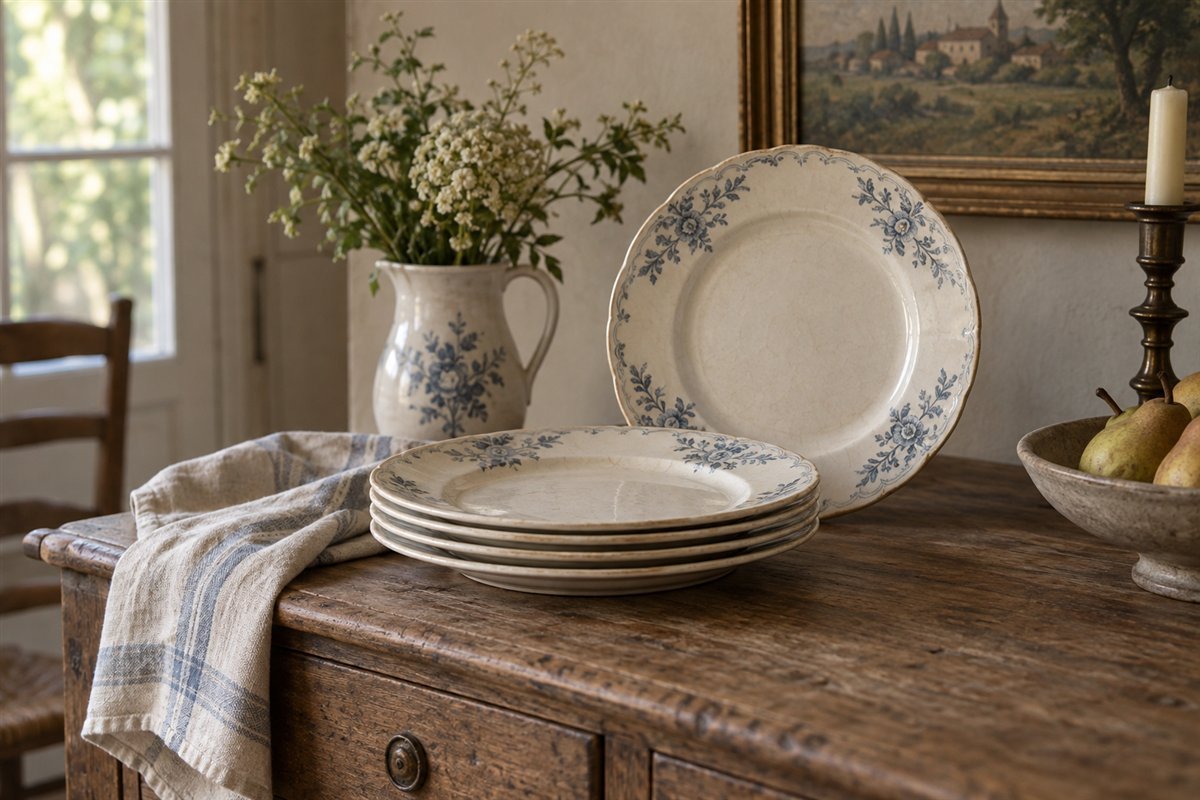
Start with the object, not just the category
Majolica terminology varies across collecting contexts. The V&A distinguishes its Italian Renaissance maiolica holdings from its nineteenth-century art pottery collections. This is a useful reminder to establish which tradition and period a seller means rather than rely on the word alone. Explore the V&A ceramics collection.
Write down the visible features of your plate: a plain or modelled surface, the colour of the exposed body, the decoration and how the glaze covers the underside. These observations give you a basis for comparison even when the attribution is incomplete.
Read the complete mark and record its source
Request an in-focus photograph of the whole underside, followed by close-ups of printed, painted or impressed marks. Include numbers and symbols rather than cropping down to a maker’s name. Note whether the mark is clear, partly legible or only reported by the seller.
Compare the mark with a documented reference and check whether the proposed pattern and shape are consistent with it. An isolated stamp is not a complete condition or authenticity assessment. If a seller proposes a precise production date, ask what evidence narrows the date to that period.
Look around raised edges and the underside
Ask for side views as well as a photograph from above. Raised leaves, scalloped rims and other projecting details deserve separate photographs. Request a written list of chips, cracks, restored areas, staining and worn decoration. A repaired area can be relevant to your decision even when it is difficult to see in the main image.
Cracks in the glaze and a crack through the ceramic body are different observations; ask which is present and where. Do not assume that a photograph establishes suitability for food use. This guide concerns identification and buying decisions, not a test of a particular glaze or repair.
Completing a group of plates
Match the outline, diameter, depth, relief pattern, underside and mark before focusing on colour alone. Photographic lighting can change the appearance of a glaze. Ask the seller to photograph candidate pieces together when possible, with differences called out explicitly.
A similar plate may still be a welcome addition if you want a related group rather than an exact set. Decide that before starting a search. It will help you reject unsuitable candidates without confusing “same maker,” “same pattern” and “same size.”
- Keep front, reverse and side photographs of the reference plate.
- List the number of plates wanted and required dimensions.
- State whether repaired pieces or glaze variation are acceptable.
- Ask for a total quote including protective packing and delivery.
Continue with French faience, majolica and ironstone, or ask about finding a missing plate.
Common questions
Does an unmarked plate have no value?
A missing mark does not settle the question. Identification and value depend on the object and available evidence; this page does not provide an appraisal.
Can a photograph prove that two glazes match?
Not reliably on its own. Lighting and image processing can affect colour. Compare photographs under similar conditions and ask about visible differences.