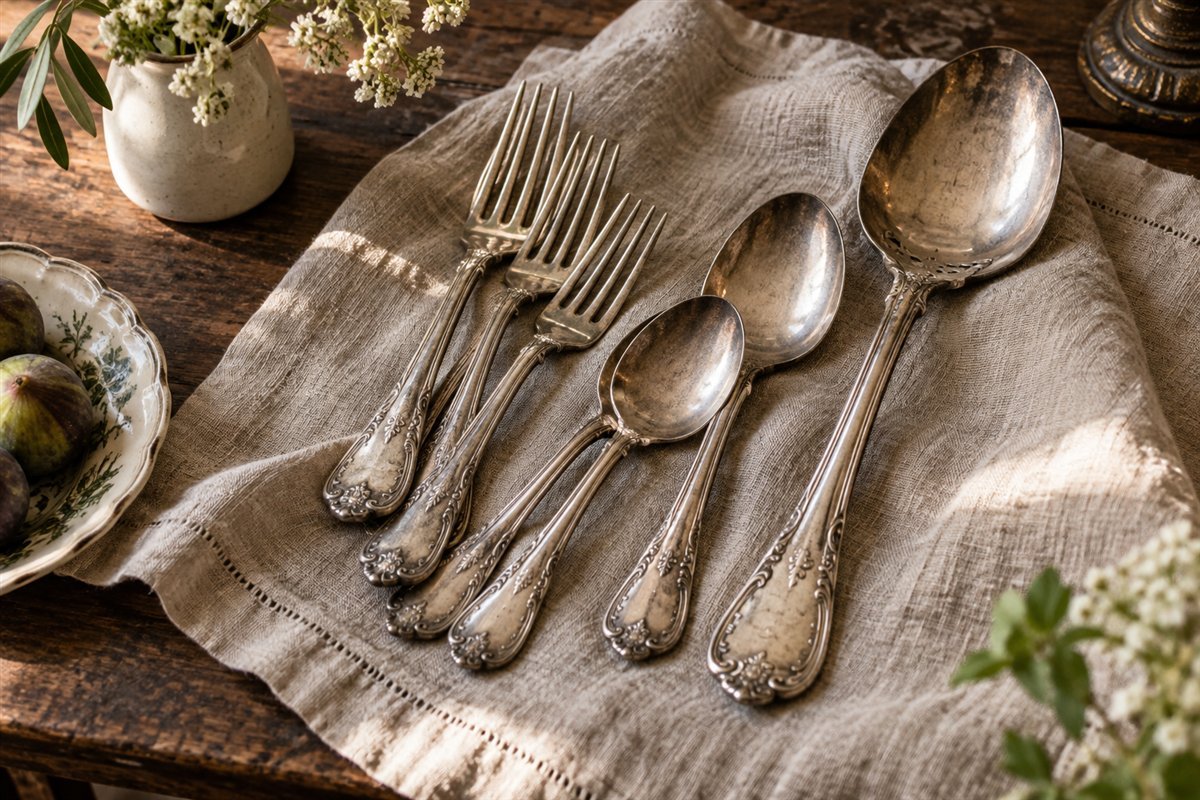
Which cheese knife suits your table?
A narrower blade presents less surface to a soft cheese, while a firm cheese needs a tool designed for controlled cutting. A forked tip can help transfer a portion. Different shapes are useful for different tasks; there is no reason to assemble a large matching set if you will use only one or two pieces.
Check the blade length against the size of the board and the way guests will serve themselves. A small utensil that looks elegant in a photograph may be awkward for a large wheel or a hard cheese. Do not force an old or fragile knife through something beyond its intended use.
French vintage cheese knives: read the whole object
Photograph marks on both the blade and handle where accessible. The two parts may use different materials or come from different production periods. A silver-colored handle is not automatically sterling silver, and a French-style pattern does not by itself identify a French maker.
Record the overall length, weight if available and the form of the handle joint. Ask about replaced blades, repairs and mismatched pieces. Our silverplate guide explains why a maker’s name, material description and pattern identification should be recorded separately.
Condition, cleaning and food use
Inspect the edge, tip, handle and connection between blade and handle. Look for looseness, corrosion, splits and repairs. Ask what is known about the materials and suitability for food use; an attractive antique serving piece may be better kept for display if those points remain uncertain.
Follow instructions appropriate to the materials and construction. Do not assume a vintage knife is dishwasher-safe or suitable for soaking, especially where a handle is filled, glued or made from a different material. Obtain specialist advice when the construction is unclear.
Set a relaxed French cheese course
Give each serving tool enough room on the board and keep a resting place nearby. Plain plates and a washable cloth let an ornate handle stand out without making the table busy. A small bread plate or separate bowl for accompaniments keeps the serving area easier to use.
For a missing knife in an existing service, compare measurements and marks rather than the pattern name alone. Photograph a matching fork or spoon beside a ruler and explain whether you want a close visual match or an exact replacement before requesting a search.